Measure New
Formwork Pressure Box PM-412
- Two pressure connections: at the bottom and halfway up
- Reads both sensors every second
- LTE-M with SIM card: no laptop or Wi-Fi needed
- Larger battery pack than the Sensorbox BM-413
NewFirst field tests running
See the formwork pressure while you pour.
How hard the concrete presses on the formwork depends on how fast you pour and how fast it stiffens. Verboom Formwork Pressure measures it every second, at the bottom and halfway up the wall. If the pressure goes above the limit from your formwork design calculation, you get a notification.

Fresh concrete first presses like a heavy liquid: the deeper below the concrete surface, the harder. Only when it stiffens does the pressure level off.1 The formwork design counts on that levelling off. System formwork for walls is usually designed for about 80 kN/m², far below what a tall wall would give as a liquid.4
Self-compacting concrete (SCC) and tall walls press up to the full liquid pressure, the hydrostatic pressure. In the cold, with a retarder or with low-carbon cement, the concrete stiffens later, and then the pressure keeps rising. The calculation assumes a setting time; whether it holds on the day of the pour, you only see if you measure.1
If the pressure becomes higher than the formwork can take, it bulges, the joints leak and honeycombing appears. The American guide ACI 347R-14 calls measuring pressure during the pour “a wise precaution” for SCC mixes that have not yet proven themselves.2
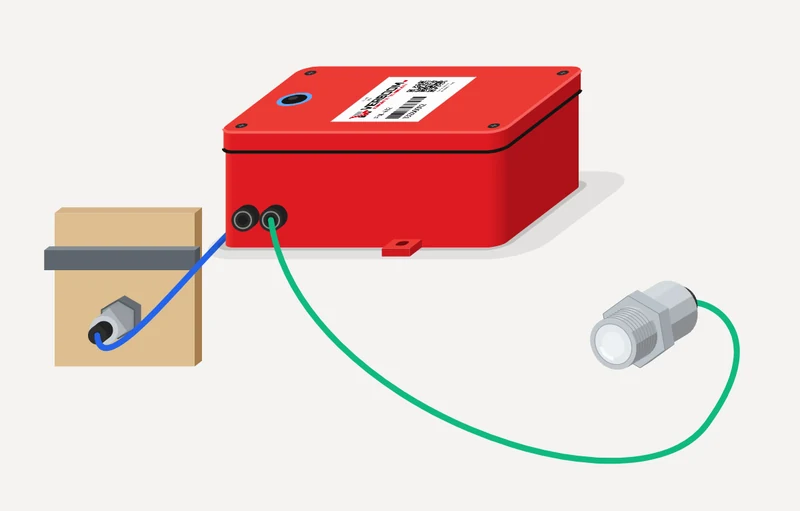
The Formwork Pressure Box PM-412 reads two formwork pressure sensors every second and sends the pressure via LTE-M to the Verboom Platform.

Two sensors per wall or mould: at the bottom, where the pressure is highest, and halfway up. The mounting socket sets the diaphragm exactly flush with the formwork face, so there is no cavity to clog up.
Just before the pour, you set the zero point with the formwork empty. After that the box measures both points every second, for as long as you pour.
If the pressure goes above the limit you set yourself, you get a notification by app, text or email. Also if a sensor is not connected properly.
The curve of every pour is in the platform: bottom and halfway up, next to your limit. That way you can show afterwards how the pressure developed.
Until now, the measurement started once the concrete was in place. With Formwork Pressure it starts at the first cubic metre. After the pour, the same pour carries on in the Verboom Platform: the Sensorbox measures the temperature in the concrete, and the platform determines maturity and strength until you can strike the formwork.
The platform calculates using the maturity method (NEN 5970), with the calibration curve of your mix.
The sensor goes into any formwork and any mould, whatever the make. You do not need special formwork to measure the pressure.
Where you pour fast, with flowable concrete or pump from below. The mounting socket goes through the plywood. If there is no sensor in the socket, a blanking plug closes it so that it does not leak.
In a steel mould, the socket is welded in. The sensor then sits in the same place for every pour, and you get the same measurement for every pour.
You see the pressure while you pour, and you get a message as soon as it goes above your limit.
With the LED tower as an option: green means carry on, flashing red means slow down.
Your limit from the calculation is set as an alarm in the platform. Afterwards you see whether the pour stayed within it.
The sensor is fixed in the mould. The same measurement for every pour, to compare side by side.
The limit comes from your formwork design calculation, for example to DIN 18218 or, in the Netherlands, the older NEN 6722.13 You enter it in the platform as the alarm limit. We do not determine it.
Measuring does not replace the calculation, nor the inspection of ties and props. Measuring tests the assumptions of the calculation, at a moment when you can still adjust.
Two sensors measure the pressure at two places in the formwork face. They tell you nothing about the forces in ties and props.
Box, sensors and installation parts, separately or as a set. You will hear about price and delivery at the field test.
The first field tests are running. Do you have a tall wall, a column or a mould with SCC where you want to see the formwork pressure? Then we will look together at whether it fits into the field test.